When computing polars with XFoil from the Gomboc GUI, I obtain better polar results (no red flags) when using the option ”Intersect CL curve at alpha = 0” instead of ”at Cl= 0”.
Do you know why? Is this an option you would recommend?
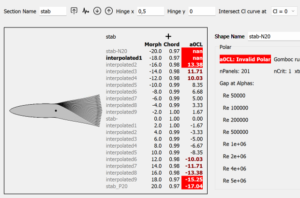
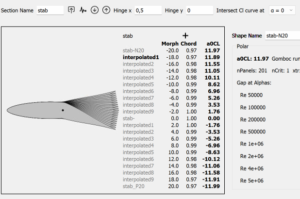

First note that to compute the lifting line, only the a0CL is needed from the polars (for the pure inviscid flow of the lifting line, e.g. induced lift/drag). The actual shape of the polar is used in post-processing step for viscous effects.
There is not a uniquely correct way to find that a0CL from the polar curves. “at CL = 0” is usually fine. This just gets where the actual curve crosses the CL = 0 axis. The other option is to take the point “at alpha = 0”, and then extrapolates to CL = 0 using the theoretical slope of 2pi.
It looks like on the left you have high flap angles, and probably the CL = 0 point is not in the part of the curve which has a nice slope close to 2pi. On the right it doesn’t complain, but the result doesn’t look great either. Basically, additional flap has almost no influence: it’s stuck at a0CL = 11. Looking at the curves, we can guess that the alpha = 0 point is in the stalled region, which could explain why it all extrapolates to ~11 degrees.
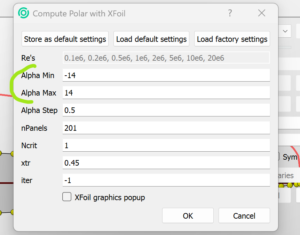
There is no predefined way to deal with that properly, but the problem of not finding the value could come of the alpha sweep range not being in the correct range for these flap angles (e.g. all CL positive as opposed to centred around CL = 0).
Our suggestion would therefore be to keep the “at CL = 0” mode but try to update the alpha range for the extreme flap angles before running XFoil from the GUI: